Reading Your Circle Y Serial Number
|
|
Learn More About Your Circle Y Saddle
We get a lot of requests to decipher serial numbers on saddles. So we've made a simple tool for you to look up your Circle Y serial number (above). Most Circle Y serial numbers are located on a silver plate or leather strap under the mounting side of your saddle.
Enter your serial # as one continuous number without dashes (ex. 1157860104)
How to read your Circle Y serial number
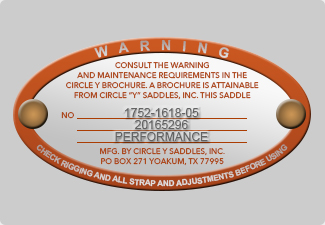
May 2006 to Present
The first four numbers represent the model # of the saddle. (1752)The next two numbers tell the seat size of the saddle. (16)
The following two numbers depict the color of the saddle. (18)
The last two numbers describe the tree width of the saddle. (05)
Simply enter the 10 digit number (the top number on sample plate to the left) without spaces or dashes into our program above to learn more about your saddle.
Discover the specifications, special features, and customer reviews of your saddle.
In addition to the the serial number, a date code will be included on the plate, along with the long serial number, which will tell the year of manufacture and the unique number for that saddle (example 20090001- which is 2009 and 0001 the unique number for the saddle).
Example: 1234-5678-90
1234: Saddle Model #
5: Seat & leather color
67: Seat size
8: Saddle color
90: Tree width
How to read your Circle Y serial number
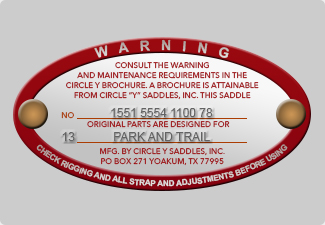
1990s to April 2006
The first four numbers represent the model # of the saddle. (1551)The next number describes the tree width of the saddle. (5)
The following two numbers describe the seat size of the saddle. (55)
The last single number depicts the color of the saddle. (4)
The next four digits tell the month and year made. (1100)
The last two digits are unique manufacturer numbers. (78)
Simply enter the 10 digit number (the top number on sample plate to the left) without spaces or dashes into our program above to learn more about your saddle.
Please leave out the month and year numbers, in this example, your number would be 1151555478.
This period of serial numbers are much like the above. Use the chart to determine tree sizes, seat sizes, and colors. There may be an extra number at the end (represented by CD). This just means that more than one of this type of saddle was made that day, so it got a unique number at the end.
Example: 1234-5678-90AB-CD
1234: Saddle Model #
5: Tree size
67: Seat size
8: Saddle color
90: Month made
AB: Year made
CD: Unique number
Seat Leather/Color Codes | Seat Size | Saddle Color | Tree Width |
|
|
|
|
Older Saddles - 1970s and 80s
These numbers vary greatly. The first three numbers could represent the style of the saddle. Beyond that, the number meanings are unclear.